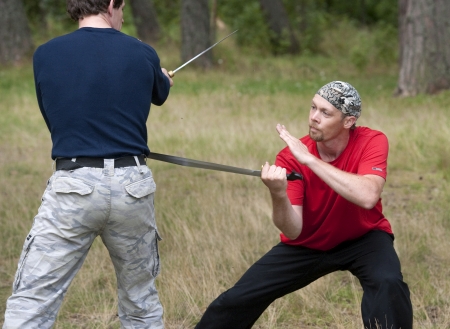
ESKRIMA, ESCRIMA, ARNIS, KALI

Eskrima is a martial art originating from the the Philippines. While several names are used for the art (eskrima, escrima, arnis, kali, estocada), they all refer to the same martial art based on the same principles. “Eskrima” comes from the Spanish word "esgrima" (meaning "fencing"). There are over a hundred different styles of eskrima, named after their place of origin, creator, or technical principles.

The eskrima practiced in the Estonian Eskrima Club is based on two styles:

BIFF escrima is a style created and developed by Jay Dobrin. The style is largely based on LATOSA ESCRIMA. BIFF escrima spread to Estonia originally through Finnish instructors, and regular trainings began in 2000.
KALAHI FCS (Kalahi Filipino Combat System) is a style that arrived in Estonia in 2017, directly from the Philippines. The roots of the style originate from GM Ernesto Presas' Kombatan system.
History of eskrima

There is no known specific founder or exact time of creation for Eskrima. It is known that the technical basis of Eskrima began to develop in the Philippines sometime in the mid-17th century on the island of Cebu, which was under Spanish control at the time.
The ruling governor needed fighters to carry out conquests on other islands in the archipelago and to protect the coastal areas from constant pirate attacks. To this end, local residents were recruited and taught the basics of Spanish fencing. As there were not enough swords to go around, handy tools, or Bolos (blades similar to machetes), were used instead.
In the tropical archipelago of the Philippines, the Bolo is a common everyday tool, available in the majority of households. Gradually, eskrima began to spread throughout the archipelago, and based on the different masters' preferences, different styles began to develop.
Thus, Eskrima/Arnis/Kali is a hybrid martial art that combines local Filipino fighting techniques and traditional tools with the influence of Spanish fencing.